Original: $350.00
-65%$350.00
$122.50The Story
6b. Jules Verne. 1890
Notes
IVerne loved exotic peril. Encounters “among cannibals,” pirates, or hostile tribes appear in several of his novels (Around the World in Eighty Days, The Mysterious Island, Journey to the Center of the Earth). These scenes were meant to thrill 19th-century readers hungry for adventure.
-
He rarely traveled far himself. Despite vivid descriptions of distant peoples, Verne gathered most of his information from travel journals, maps, and scientific reports—proving his imagination did most of the heavy lifting.
-
The New Guinea episode reflected Victorian fears. European readers of the 1870s were fascinated—and frightened—by stories of “cannibals,” which Verne used to heighten tension rather than provide anthropological accuracy.
-
Not pure horror—often playful. Even in dangerous moments, Verne injected humor. Passepartout’s near-capture “among the cannibals” is suspenseful but also comic, fitting Verne’s light, fast-paced tone.
-
Science over savagery. Verne usually portrayed intelligence, ingenuity, and calm reasoning (especially through characters like Fogg) as the true tools for survival—not brute force.
-
A reflection of his era. Today, readers recognize these depictions as shaped by colonial attitudes of the 19th century, but they remain a fascinating window into how adventure literature once imagined the wider world.
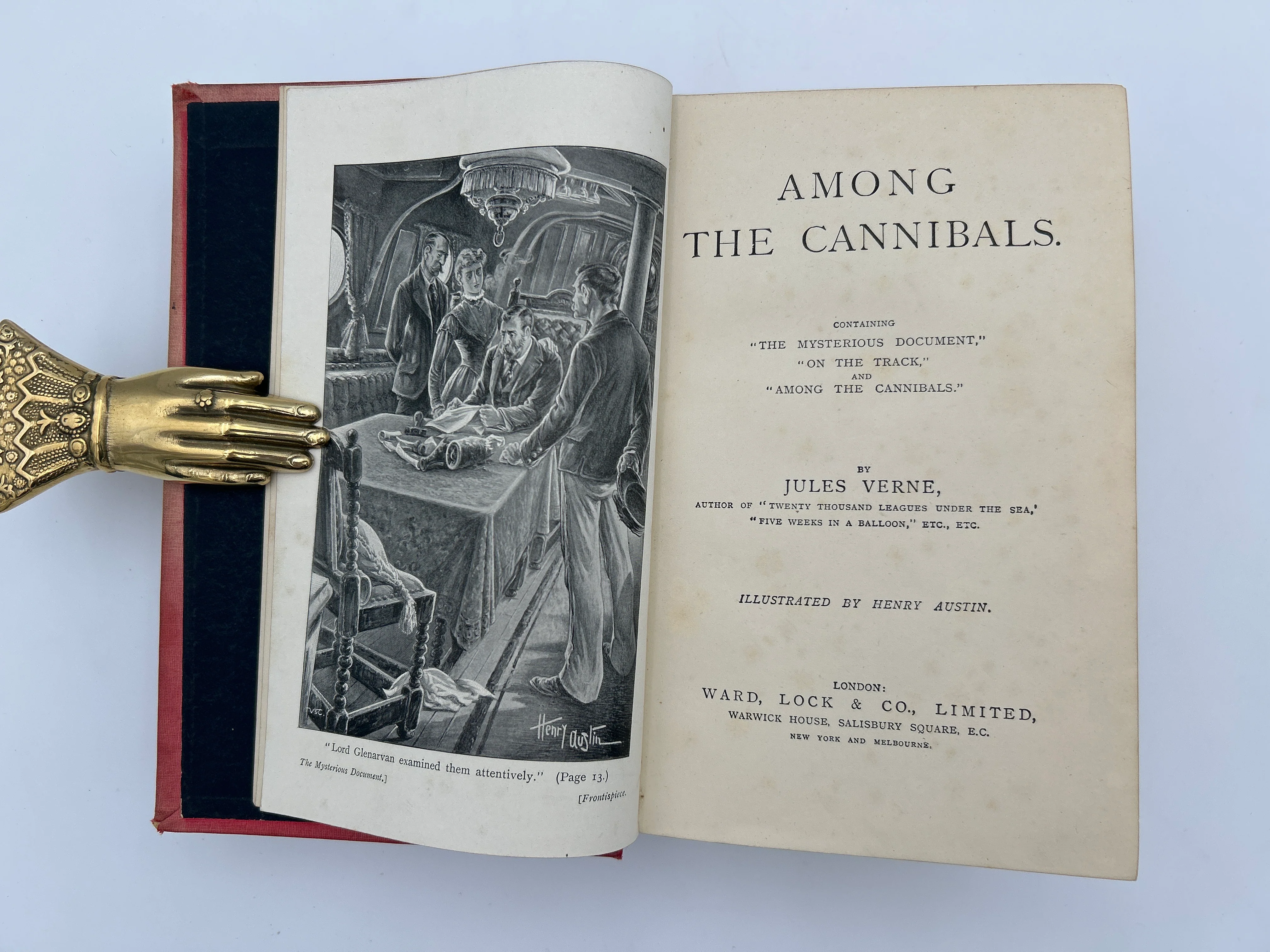
Lord Glenarvan sets off to find Harry with his wife and Harry's children and the crew of the yacht,the Duncan. As they set off on the chase they are joined by an unexpecetd passenger in the form of French geographer, Jaques Pagenel.
Description
Red cloth cover with illustration on front, spine in rust color. Spine is faded to a light tan, black and gold lettering on spine and front.

Details & Craftsmanship
Every detail has been carefully considered to bring you the perfect product.
Details & Craftsmanship
Every detail has been carefully considered to bring you the perfect product.

Details & Craftsmanship
Every detail has been carefully considered to bring you the perfect product.
Description
6b. Jules Verne. 1890
Notes
IVerne loved exotic peril. Encounters “among cannibals,” pirates, or hostile tribes appear in several of his novels (Around the World in Eighty Days, The Mysterious Island, Journey to the Center of the Earth). These scenes were meant to thrill 19th-century readers hungry for adventure.
-
He rarely traveled far himself. Despite vivid descriptions of distant peoples, Verne gathered most of his information from travel journals, maps, and scientific reports—proving his imagination did most of the heavy lifting.
-
The New Guinea episode reflected Victorian fears. European readers of the 1870s were fascinated—and frightened—by stories of “cannibals,” which Verne used to heighten tension rather than provide anthropological accuracy.
-
Not pure horror—often playful. Even in dangerous moments, Verne injected humor. Passepartout’s near-capture “among the cannibals” is suspenseful but also comic, fitting Verne’s light, fast-paced tone.
-
Science over savagery. Verne usually portrayed intelligence, ingenuity, and calm reasoning (especially through characters like Fogg) as the true tools for survival—not brute force.
-
A reflection of his era. Today, readers recognize these depictions as shaped by colonial attitudes of the 19th century, but they remain a fascinating window into how adventure literature once imagined the wider world.
Lord Glenarvan sets off to find Harry with his wife and Harry's children and the crew of the yacht,the Duncan. As they set off on the chase they are joined by an unexpecetd passenger in the form of French geographer, Jaques Pagenel.
Description
Red cloth cover with illustration on front, spine in rust color. Spine is faded to a light tan, black and gold lettering on spine and front.