The Story
6B Holy Bible. Cleveland: World Publishing Company, ca. 1955.
Notes
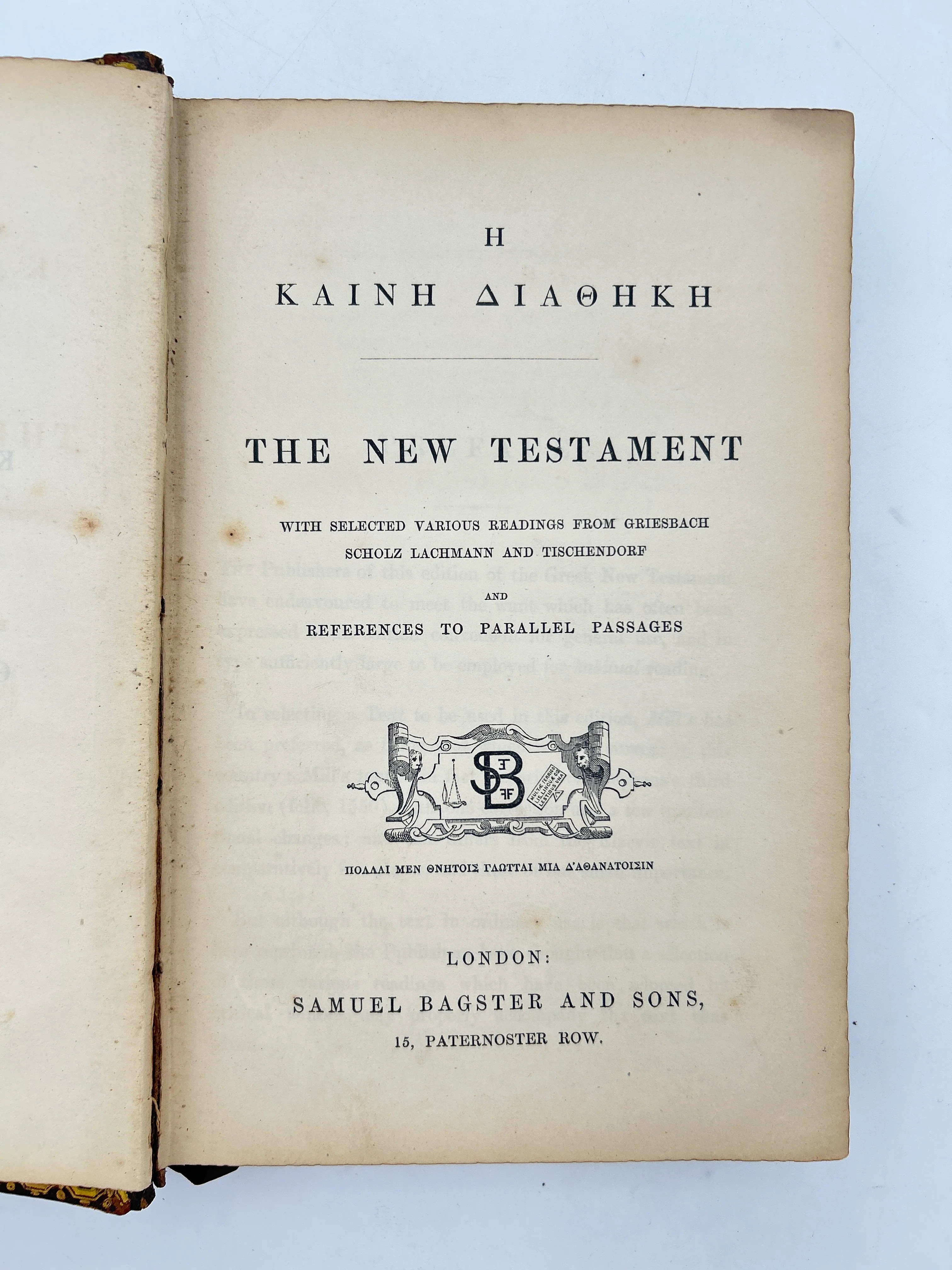
The history of the printing of the Bible is closely tied to the invention of the movable-type printing press in Europe. Before printing, Bibles were copied by hand, usually in Latin, making them rare, expensive, and accessible mainly to clergy and scholars. This changed dramatically around 1455 when Johannes Gutenberg printed the Gutenberg Bible in Mainz, Germany. It was the first major book produced using movable metal type and marked the beginning of mass-produced books in the West. Printing allowed the Bible to be reproduced more quickly, cheaply, and consistently, leading to wider distribution and literacy. Over time, Bibles were increasingly printed in vernacular languages rather than Latin, which helped spread religious ideas more broadly and played a major role in the religious, cultural, and intellectual transformations of early modern Europe.
Description
Black leather zip closure with gold cross zipper pull. Yellow embossed lettering to front cover and spine. Name embossed on lower right corner Colleen Kay Staub. Red edges. Illustrated with color illustrations. Presentation page filled in with pen and inscription on preliminary fly leaf: “an award for perfect attendance at Sunday School for fifty-two consecutive Sundays.” Nice condition.

Details & Craftsmanship
Every detail has been carefully considered to bring you the perfect product.
Details & Craftsmanship
Every detail has been carefully considered to bring you the perfect product.
Details & Craftsmanship
Every detail has been carefully considered to bring you the perfect product.
Details & Craftsmanship
Every detail has been carefully considered to bring you the perfect product.
Description
6B Holy Bible. Cleveland: World Publishing Company, ca. 1955.
Notes
The history of the printing of the Bible is closely tied to the invention of the movable-type printing press in Europe. Before printing, Bibles were copied by hand, usually in Latin, making them rare, expensive, and accessible mainly to clergy and scholars. This changed dramatically around 1455 when Johannes Gutenberg printed the Gutenberg Bible in Mainz, Germany. It was the first major book produced using movable metal type and marked the beginning of mass-produced books in the West. Printing allowed the Bible to be reproduced more quickly, cheaply, and consistently, leading to wider distribution and literacy. Over time, Bibles were increasingly printed in vernacular languages rather than Latin, which helped spread religious ideas more broadly and played a major role in the religious, cultural, and intellectual transformations of early modern Europe.
Description
Black leather zip closure with gold cross zipper pull. Yellow embossed lettering to front cover and spine. Name embossed on lower right corner Colleen Kay Staub. Red edges. Illustrated with color illustrations. Presentation page filled in with pen and inscription on preliminary fly leaf: “an award for perfect attendance at Sunday School for fifty-two consecutive Sundays.” Nice condition.