Original: $30.00
-65%$30.00
$10.50The Story
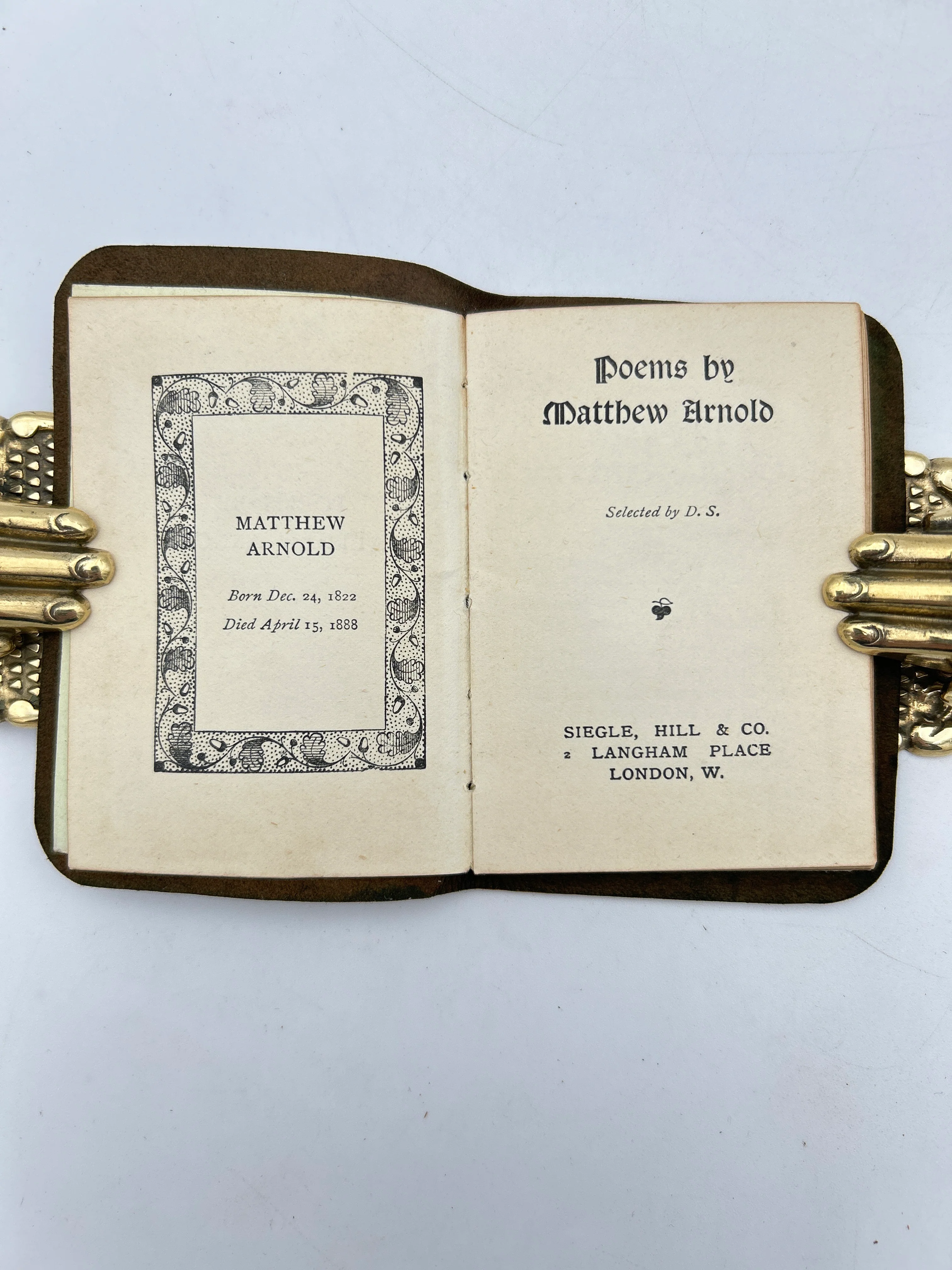
6j Siegel, Hill & Co., ca. 1910.
Notes
Matthew Arnold (1822–1888) was an English poet and cultural critic known for his reflective, often melancholic verse and his thoughtful essays on society, religion, and education. His poetry, including works like Dover Beach and The Scholar-Gipsy, explores themes of faith, doubt, the beauty of nature, and the search for meaning in an era of scientific progress and social change. As a critic, Arnold advocated for the moral and civilizing power of culture and literature, emphasizing the need for intellectual and spiritual development in modern society.
Miniature books grew especially popular in the late nineteenth and early twentieth centuries, when improvements in printing, paper quality, and typesetting made it possible to produce readable texts at very small sizes. Their appeal blended novelty, craftsmanship, and collectability: readers enjoyed the surprise of fully functional books small enough to fit in a pocket, while collectors prized the fine bindings, gilt lettering, and clever design challenges they represented. Miniature volumes were often given as gifts or souvenirs and frequently featured well-known classics, poetry, or religious texts, since familiar works lent themselves well to abbreviated or compact formats.
Description
Miniature. Blue/green suede binding. Gilt edges and gilt lettering on spine. Pictorial endpapers. Fading to spine. Fine condition.
Details & Craftsmanship
Every detail has been carefully considered to bring you the perfect product.
Description
6j Siegel, Hill & Co., ca. 1910.
Notes
Matthew Arnold (1822–1888) was an English poet and cultural critic known for his reflective, often melancholic verse and his thoughtful essays on society, religion, and education. His poetry, including works like Dover Beach and The Scholar-Gipsy, explores themes of faith, doubt, the beauty of nature, and the search for meaning in an era of scientific progress and social change. As a critic, Arnold advocated for the moral and civilizing power of culture and literature, emphasizing the need for intellectual and spiritual development in modern society.
Miniature books grew especially popular in the late nineteenth and early twentieth centuries, when improvements in printing, paper quality, and typesetting made it possible to produce readable texts at very small sizes. Their appeal blended novelty, craftsmanship, and collectability: readers enjoyed the surprise of fully functional books small enough to fit in a pocket, while collectors prized the fine bindings, gilt lettering, and clever design challenges they represented. Miniature volumes were often given as gifts or souvenirs and frequently featured well-known classics, poetry, or religious texts, since familiar works lent themselves well to abbreviated or compact formats.
Description
Miniature. Blue/green suede binding. Gilt edges and gilt lettering on spine. Pictorial endpapers. Fading to spine. Fine condition.